
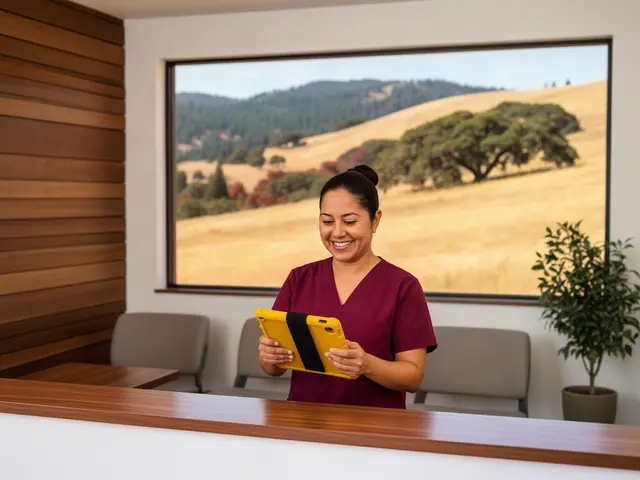
Goldwell Commercial Capital, a small-business funding broker in Medford, Oregon, arranges medical and dental practice financing through lending partners: equipment financing for chairs, imaging and chiropractic tables, term loans for build-outs and buy-ins, and working capital for reimbursement gaps. Jackson County had 544 ambulatory health care establishments in 2023. Partners decide every request and set terms.
| Outpatient practices counted, county-wide | 544 in Jackson County in 2023 (County Business Patterns) |
|---|---|
| Physician offices | 158 (CBP 2023) |
| Dental offices | 100 (CBP 2023) |
| Outpatient health care payroll | Roughly $579.9 million in 2023 |
| County health care and social assistance payroll | About $1.17 billion, the largest of any sector |
Health care in Jackson County, OR
Health care and social assistance (NAICS 62) carried the largest annual payroll of any sector in Jackson County in 2023, about $1.17 billion across 819 establishments (U.S. Census Bureau, County Business Patterns 2023). Within it, ambulatory health care, the offices and outpatient services where most practices sit, had 544 establishments, 7,520 employees and about $579.9 million in payroll. There were 158 physician offices with 3,045 employees and 100 dental offices with 1,073 employees.
Practice size varies: 41.1 percent of physician offices had fewer than five employees, but only 22.0 percent of dental offices did. The county also had 1,128 ambulatory health care businesses with no paid employees in 2024 (Nonemployer Statistics 2024), a separate count.
Chairs, imaging and chiropractic equipment
Dental chairs, intraoral scanners, digital X-ray, sterilizers, ultrasound units and chiropractic tables all fit equipment financing, where the asset normally secures the loan. Chiropractic equipment financing works the same way as a dental chair: quote, down payment if any, term. Technology that ages quickly, such as imaging software or scanners, may suit a lease with a defined buyout better than a long loan.
Ask whether installation, training and software licenses can be included. Some partners fund only the hardware, which leaves the rest to come from cash or a separate loan.
Build-outs and moving to a new space
A treatment room needs plumbing, electrical, cabinetry and sometimes shielding, and the build-out can cost as much as the equipment. A build-out usually goes on a term loan, with equipment split onto its own financing. Partners will ask for the lease, the contractor's bid and the landlord's consent to alterations.
Physician practice buy-in loans and acquisitions
A physician practice buy-in loan, or a loan to buy an existing dental practice, is usually a term loan. Partners read the practice's historical statements and collections more than the buyer's projections, and they will want the purchase or buy-in agreement. Valuation and tax questions belong with your accountant and attorney; the partner's question is whether the practice's cash flow carries the payment.
Opening a practice from scratch
A practice with no operating history is harder to fund than one with years of collections, because partners have only the clinician's credit and plan to read. Equipment is the most approachable part, since it secures its own financing. Build-out and opening payroll are harder, and partners may ask for a larger owner contribution or additional collateral. Expect more questions, not a different process.
Patient financing is a different product
Practices are sometimes offered programs that let patients pay for treatment over time. Those are consumer credit products between the patient and a lender, and Goldwell Commercial Capital does not arrange them. Everything on this page concerns funding for the practice itself: its equipment, its space and its cash between treatment and payment.
Timing equipment around a lease
If a practice is planning to move, time large equipment purchases with the move rather than before it. Installed equipment is expensive to relocate, and a build-out designed around new equipment usually costs less than adapting a room to old equipment. Partners reviewing both requests together can see the whole plan, which tends to make the file easier to read.
Reimbursement gaps
A practice treats patients today and is paid by insurers later. When reimbursements slow, payroll and rent do not. Working capital covers a single gap; a credit line suits a practice where slow payments recur. Partners will read claims and collections history alongside bank statements.
Medical practice funding: what partners read
- Business bank statements and, where relevant, collections reports.
- Year-end financial statements and tax returns.
- Equipment quotes, lease and build-out bids.
- Buy-in or purchase agreements, for an acquisition.
- Any equipment loans or leases already running.
Dental clinic financing compared
| Need | Usually paid with | Why |
|---|---|---|
| Chair, scanner or X-ray | Equipment financing, or a lease with buyout | The asset secures it |
| New operatory build-out | Term loan | Long-lived improvement |
| Practice purchase or buy-in | Term loan | Paid back from practice cash flow |
| Slow insurer payments | Working capital or a revolving credit line | Short gap with an end |
Local figures for every sector are on Census figures for the valley, and other sectors are on sectors partners fund.
By Goldwell Commercial Capital · Updated